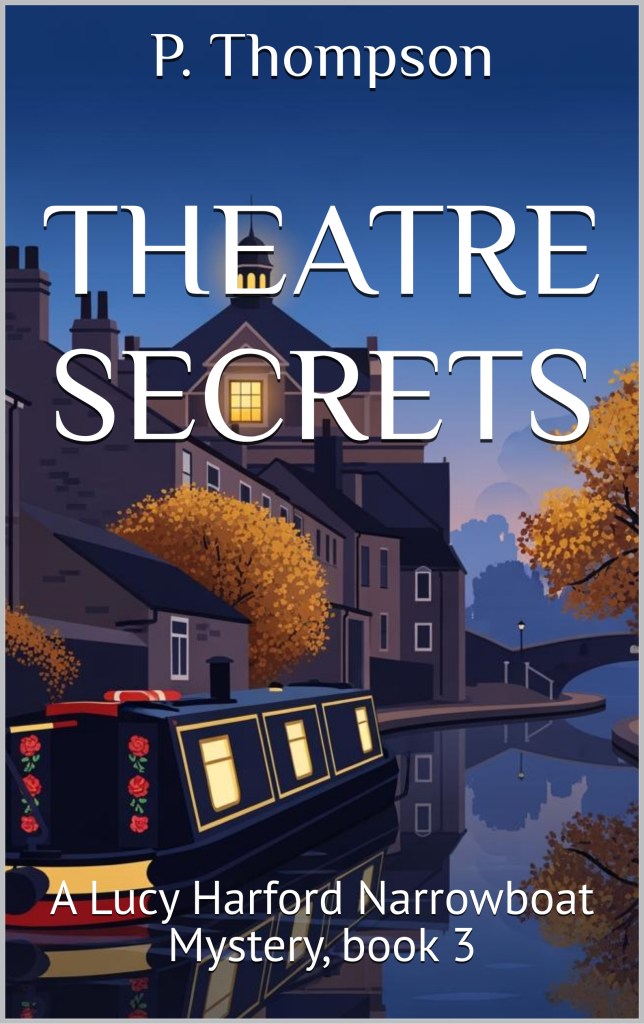
A Lucy Harford Narrowboat Mystery, book 3
Part of the Lucy Harford Mysteries
Lucy’s third adventure takes her to Stavewell — a market town with a canal basin, a converted wharf, and a Victorian playhouse that has been carefully, lovingly, and not entirely honestly maintained for decades. She arrives to paint a building. She stays to understand a death.
She came to document the building. She didn’t know her drawings would become evidence.
Lucy Harford’s latest commission brings her to Stavewell’s Victorian Playhouse — a converted corn exchange whose ironwork ceiling is original and whose safety reports, as it turns out, are not. The Stavewell Players are preparing for opening night of an ambitious new production, and the building hums with the particular tension of a community that has been together long enough to accumulate grievances alongside loyalties.
Then someone dies on opening night, struck by a counterweight from the fly system above the stage. The police call it a terrible accident. The building’s condition, after all, speaks for itself.
Lucy is not so sure. She has been drawing this theatre — carefully, methodically, the way heritage documentation requires. And something is wrong.
The investigation draws in her journalist friend Emma, whose documentary research uncovers a buried professional betrayal; DI Baptiste, who is sceptical about Lucy’s methods and eventually grateful for them; and a community full of people with genuine secrets — including a stage manager whose devotion to the building led him somewhere he never intended to go, a leading actress whose composure conceals something consequential, a dying playwright whose final work is closer to the truth than anyone realises, and a young man still working out what he feels about the father he came to Stavewell to find.
Understanding why the killer acted in the way they did, turns out to be the hardest part of all.
FAQ: Hidden Secrets
Q: Q: Can I read Theatre Secrets without reading the earlier books? Yes. Each book is a self-contained mystery with its own setting, community, and resolution. Theatre Secrets introduces Lucy’s key relationships — her friendship with Emma, her narrowboat life with Sir Meows-a-Lot — in enough detail that you won’t feel you’ve missed something essential. That said, starting with Scarecrow Secrets gives you the full arc of who Lucy is and how she got here, and some readers find that the series rewards being read in order.
Q: What makes this book different from the first two? The investigation in Theatre Secrets turns on something Lucy has been doing since page one: drawing. Her heritage commission sketches of the Playhouse interior become inadvertent time-lapse evidence — a record of small changes she noticed without understanding what she was noticing. The puzzle is solved not through interrogation or lucky coincidence but through Lucy’s particular way of seeing the world. Her artist’s spatial reasoning, which has always been part of who she is, becomes the tool that cracks the case open.
Q: Is the Playhouse setting important to the plot? Very. The building’s history — its original construction as a Victorian corn exchange, its conversion to a theatre, the decades of careful maintenance and occasional creative record-keeping — is woven through the investigation. The fly system, the backstage geography, the airtight scene dock that was once a grain store: the Playhouse’s architecture matters. Lucy draws it because it’s her job. The drawing matters because she’s the right person to understand what she’s drawn.
Q: The book is described as having emotional weight alongside the puzzle. What does that mean?
The killer in Theatre Secrets is not someone who acted from simple malice. They acted from something much quieter. Lucy recognises something in their situation. She doesn’t forgive what they did. But she understands it, and that understanding inflects the resolution in ways that linger after the mystery is solved.
Q: How does Sir Meows-a-Lot fit in? In the way he always does — by being entirely a cat, and by being present at exactly the right moment. There is an incident involving a locked door, a particular kind of agitation, and consequences that matter.
Theatre Secrets is perfect for fans of:
- Louise Penny’s Three Pines novels — Communities that feel genuinely inhabited, characters whose complexity rewards close attention, and mysteries where understanding why matters as much as discovering who. Penny proved that a small, particular world can carry enormous emotional weight. Lucy’s canal communities work in the same tradition — intimate settings where murder reveals what was always there beneath the surface.
- Elly Griffiths’ Ruth Galloway series — A protagonist whose professional skills are inseparable from how she sees the world, settings with real atmospheric weight, and mysteries grounded in place and history. Like Ruth, Lucy solves crimes through the specific way she observes. In Lucy’s case, it is an artist’s eye trained to notice proportion, space, and what doesn’t fit.
- Ann Cleeves’ Vera Stanhope novels — Landscapes that shape the stories told within them, communities bound by loyalty and silence in equal measure, and an investigator who reads people as carefully as evidence. Lucy shares Vera’s patience and her understanding that the truth about a crime is usually tangled up in the truth about a community.
Sir Meows-a-Lot at the Playhouse
Lucy’s ginger tabby — former stray, current resident of The Curious Cat, and persistent presence in places he has no business being — takes to the Stavewell Playhouse with the confidence of a cat who has decided that backstage access is a reasonable expectation.
He discovers things, as he always does. Not because he understands what he’s found, but because a cat with no respect for restricted areas and an interest in interesting smells tends to end up where the interesting things are. The timing is, as ever, his own business.

The Curious Cat in Stavewell
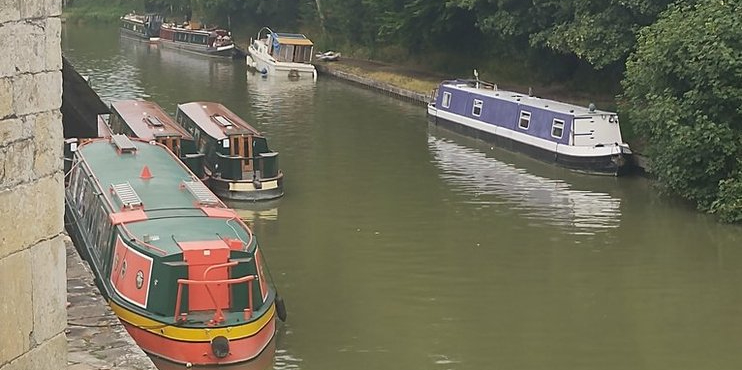
Lucy’s 57-foot narrowboat — deep blue hull, traditional crimson and gold decoration, brass fittings kept polished — finds a mooring in Stavewell’s canal basin for the duration of the investigation. The basin is sheltered, the light in late September comes off the water at an angle that rewards a painter’s attention, and the walk along the towpath to the wharf arts centre takes eight minutes.
The boat is Lucy’s home, her studio, and her retreat — the place she returns to when the investigation has become too much, where she spreads her sketches on the fold-down table and thinks through what she’s seen. The multi-fuel stove. The paintings drying on the rack. The sound of water against the hull at night. A life that continues alongside the mystery, regardless of it.
Some of her sketches from the Stavewell commission will eventually become prosecution exhibits. The ones that weren’t evidence — the ones that stayed hers — dry on the rack in the final chapter.
Schema
html
json{
  "@context": "https://schema.org",
  "@type": "Book",
  "name": "Theatre Secrets",
  "author": {
    "@type": "Person",
    "name": "P. Thompson",
    "description": "Cozy mystery author",
    "url": "https://pthompsonmysteries.com/about/"
  },
  "genre": ["Cozy Mystery", "British Cozy Mystery", "Amateur Sleuth Mystery", "Literary Mystery", "Theatrical Mystery"],
  "description": "When the director of the Stavewell Players dies on opening night, struck by a counterweight from the theatre's fly system, the death is assumed accidental. But Lucy Harford has spent a week drawing the Playhouse for a heritage commission — and the geometry of her sketches doesn't match an accident. As she traces what her painter's eye recorded without understanding, she uncovers a community full of genuine secrets, a building whose safety reports were written with more devotion than accuracy, and a killer whose motive runs twenty years deep.",
  "datePublished": "2026",
  "isPartOf": {
    "@type": "BookSeries",
    "name": "The Lucy Harford Narrowboat Mysteries",
    "position": "3"
  },
  "mainCharacter": [
    {
      "@type": "Person",
      "name": "Lucy Harford",
      "description": "Former police constable turned watercolour artist, living aboard narrowboat The Curious Cat on England's canal network"
    },
    {
      "@type": "Thing",
      "name": "Sir Meows-a-Lot",
      "description": "A formerly stray ginger tabby who adopted Lucy and now travels the canal network with her"
    }
  ],
  "setting": {
    "@type": "Place",
    "name": "Stavewell",
    "description": "A fictional English market town with a canal basin, a converted wharf arts centre, and a Victorian playhouse — a former corn exchange — that is the setting for an amateur dramatic society's opening night and the murder that follows"
  },
  "keywords": ["narrowboat mystery", "canal mystery", "British cozy mystery", "theatre mystery", "literary mystery", "amateur detective", "community secrets", "Victorian playhouse", "cozy mystery series"],
  "about": [
    {
      "@type": "Thing",
      "name": "The Stavewell Playhouse",
      "description": "A Victorian corn exchange converted to a theatre, whose ageing fly system and carefully managed safety reports become central to the murder investigation"
    },
    {
      "@type": "Thing",
      "name": "The Stavewell Players",
      "description": "An amateur dramatic society preparing to stage The Toll House, a new play by a local playwright — a community bound by long loyalties and longer grievances"
    },
    {
      "@type": "Thing",
      "name": "Heritage Lottery Fund bid",
      "description": "A funding application to restore the Stavewell Playhouse, whose success depends on secrets that the investigation threatens to expose"
    }
  ],
  "url": "https://pthompsonmysteries.com/theatre-secrets/",
  "sameAs": [
    "https://amazon.com/dp/[your-ASIN]"
  ]
}
 P. Thompson - Mystery Author