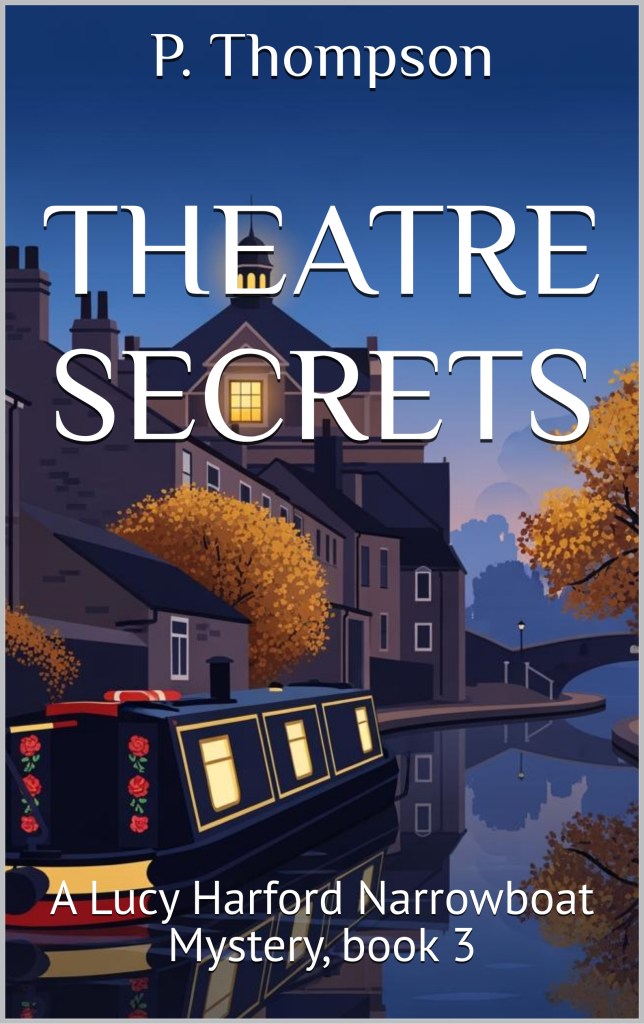
Lucy Harford is back on the water — and this time, she’s moored somewhere she wasn’t expecting to stay.
Theatre Secrets is the third Lucy Harford Narrowboat Mystery, and it’s the book where everything I’ve been learning as a writer comes together. I want to tell you a little about it — not the plot (that’s yours to discover), but what the book is trying to do and why it matters to me.
A Town with a Theatre
The story begins when Lucy moors The Curious Cat in the basin of a small market town called Stavewell. She’s there on a commission — heritage documentation of a Victorian playhouse that’s seen better days. The building is beautiful and crumbling, the kind of place where the ironwork in the ceiling is original and the pointing is falling out of the walls, where someone has been writing safety reports that aren’t entirely honest because they love it too much to let it be condemned.
Lucy is there to paint the building. She ends up painting much more than that.
I fell in love with this setting while I was writing it. Canal basin, converted wharf buildings, a café run by an Irish woman who talks at twice the speed of everyone else in the room, and a community of amateur dramatic players preparing for opening night. The Stavewell Players are talented, complicated, and held together by the kind of loyalties that form when people have known each other too long to disentangle easily. They’re also, as Lucy discovers, full of secrets.
The Painter’s Eye
If you’ve read Scarecrow Secrets or Hidden Secrets, you know that Lucy sees the world through two lenses — her former police training and her artist’s eye. In Theatre Secrets, those two ways of seeing finally become one.
Lucy’s painting isn’t decoration in this book. It’s the engine of the investigation. The sketches she makes of the Playhouse interior — careful, precise, the heritage commission work she was hired to do — turn out to document something she didn’t know she was recording. Her eye for proportion, for spatial relationships, for the way things sit in three-dimensional space, becomes the tool that cracks the case open.
I’ve wanted to write this version of Lucy since the beginning. A detective who solves a crime not through interrogation or lucky overheard conversations, but through the specific skills of her actual vocation. She draws what’s there. What’s there turns out to matter.
Deeper Water
I wrote recently about what I’ve come to call “Deep Cozy” — mysteries that keep the warmth, the community, the amateur detective, and the cat, while giving the characters room to carry real emotional weight. Theatre Secrets is the fullest expression of that idea so far.

The people in this book are not simple. The victim is complicated — talented and controlling, capable of great generosity and quiet damage, sometimes in the same conversation. The suspects carry secrets that are consequential whether or not they’re connected to the murder. And the person responsible for the killing is someone whose path to that moment didn’t begin with malice. It began with something much quieter, much slower, and much sadder.
I don’t want to say more than that. But I will say this: if you’ve ever wondered how someone capable of kindness could also be capable of something terrible, this book sits with that question. It doesn’t offer an easy answer. I hope it offers an honest one.
What Stays the Same
Lucy is still Lucy. She still favours her good leg on uneven surfaces. She still reaches for her paintbrush when the world gets complicated. She still asks careful, open questions and then listens properly to the answers — a habit from the police that turned out to be a life skill.
Sir Meows-a-Lot is still Sir Meows-a-Lot. He still turns up where he shouldn’t be. He still has a talent for drawing attention to things that matter. He still has absolutely no respect for closed doors, territorial boundaries, or the dignity of anyone trying to work.
Emma arrives with energy, questions, and a journalist’s instinct for the paper trail. Niamh — the café owner, and a new addition to Lucy’s world — brings warmth, honesty, and the kind of friendship that forms quickly when two people recognise something in each other.
And the canal is still the thread. The water that carries Lucy to these places, these people, these questions she didn’t plan to ask.
A Note on What to Expect
This is still a cozy mystery. There is tea. There is cake. There is a cat who does something at a critical moment that is entirely plausible and only slightly suspicious. The community is warm. The setting is beautiful. The puzzle is fair — every clue is visible to a reader who’s paying attention.
But Theatre Secrets goes deeper than the first two books. The emotions are real. The moral questions don’t resolve neatly. The ending will satisfy you as a mystery — I’ve worked hard to make sure of that — but it may also stay with you in ways that are less comfortable and, I hope, more honest.
If you’ve been reading Lucy’s journey from the beginning, this is where the series arrives at what it was always trying to become. If you’re new to the books, you can start here — but you might want to begin with Scarecrow Secrets and walk into the deeper water one book at a time.
Either way, I hope you’ll come to Stavewell. The basin is beautiful in autumn. The café does excellent coffee. And the Playhouse ceiling is worth the visit on its own.
Theatre Secrets will be available in a few weeks after my final revision work on it. the publication date as soon as I have it.
Thank you, as always, for reading.
P. Thompson
Technical details
{
“@context”: “https://schema.org”,
“@type”: “BlogPosting”,
“headline”: “Theatre Secrets Is Coming”,
“author”: {
“@type”: “Person”,
“name”: “P. Thompson”
},
“description”: “Lucy Harford moors in a market town with a crumbling Victorian playhouse and a community full of secrets. The third narrowboat mystery is on its way.”,
“keywords”: “Theatre Secrets, Lucy Harford, narrowboat mystery, cozy mystery, deep cozy, Victorian theatre, P. Thompson”,
“articleSection”: “Writing Updates”
}
 P. Thompson - Mystery Author
Join the conversation