Every killer in Lucy Harford’s world has one thing in common. None of them set out to become what they became.
In Scarecrow Secrets, Mrs Wembley carried her grief for years — quietly, privately, behind the composed face of a village librarian with a tidy perm and pearl earrings. She didn’t wake up one morning and decide to kill the vicar. She woke up every morning for years and decided not to, until one evening she couldn’t anymore. The confrontation she’d been putting off became the confrontation she couldn’t walk away from, and by then it was too late for composure to save her.
In Hidden Secrets, Ruth Webb built her life around protecting a family story that turned out to be a lie. She was Burybridge’s historical guardian — the person everyone trusted to know the truth about the town’s past. And she did know the truth. That was exactly the problem. When someone threatened to expose what she’d spent decades quietly managing, the same qualities that made her a meticulous librarian made her a meticulous killer. She didn’t act from rage. She acted from the conviction that some doors, once opened, couldn’t be closed again.

I didn’t plan this pattern. Looking back, I can see it was there from the first book, but I wasn’t conscious of it until I was deep into writing the third. What I kept returning to — what Lucy keeps encountering — are people whose capacity for harm grew from the same soil as their capacity for care. Grief that had nowhere to go. Loyalty that couldn’t let go. Love that became something else so gradually that the person carrying it didn’t notice the change until it was too late to change back.
The Third Book
Theatre Secrets takes Lucy to Stavewell, a small market town with a canal basin, a warm café, and a Victorian playhouse that’s falling apart beautifully. She’s there on a painting commission — heritage documentation of the building’s interior before the Lottery bid either saves it or doesn’t. She arrives expecting good light and interesting architecture. She finds a community of amateur dramatic players preparing for opening night, bound together by the complicated loyalties of people who’ve known each other too long.
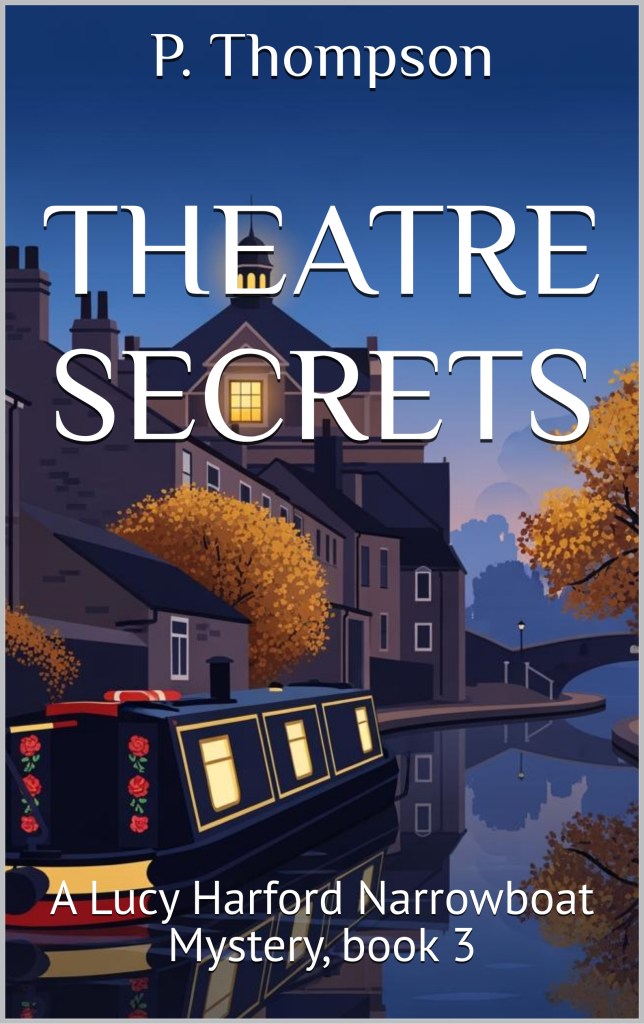
I’m not going to tell you what happens. Not the plot, not the crime, not who or how or why. What I will tell you is this: the pattern continues.
The person at the centre of this story is someone Lucy meets in the ordinary course of her work. Someone who is good at what they do. Someone whose quiet competence is the thing that makes them invisible — valued but not watched, present but not noticed, essential but never the centre of attention. And in that invisibility, something grew.
I’ve written about what I call “Deep Cozy” — the idea that these books can deliver everything readers love about the genre (the warmth, the community, the amateur detective, the cat, the satisfying puzzle) while also asking real questions about human motivation. Theatre Secrets is where that idea is most fully realised. The mystery is fair. The clues are there. The resolution works as a puzzle. But it also works as something else — a story about what happens when patience runs out, when years of carrying something finally becomes too heavy, and when the person who breaks isn’t the person anyone was watching.
Lucy’s Eye
One thing I’m particularly proud of in this book is how Lucy solves the crime. Her painter’s eye — the way she sees proportion, spatial relationships, the geometry of how things sit in three-dimensional space — has always been part of who she is. In Theatre Secrets, it becomes the investigation itself. The sketches she makes for her heritage commission turn out to be evidence she didn’t know she was collecting. She draws what’s there. What’s there tells a story nobody else could read.
I’ve wanted to write this version of Lucy since the first book. An artist whose art is the detective work — not a metaphor for it, not adjacent to it, but the actual mechanism by which the truth is found.
What to Expect
Sir Meows-a-Lot is present, opinionated, and trespassing freely. Emma arrives with questions and energy. There is an excellent café, a great deal of tea, and at least two slices of cake that matter to the plot in ways I refuse to explain. The setting is atmospheric. The community is warm. The puzzle plays fair.
And underneath all of that, there’s a question the book asks quietly and doesn’t entirely answer: how close is the distance between someone who rebuilds their life after loss and someone who doesn’t? Between someone who finds peace and someone who finds something else? Lucy has been living that question since she stepped onto The Curious Cat. In Stavewell, she meets someone who started from a very similar place and arrived somewhere very different.
That’s all I’ll say.
Theatre Secrets will be available a little later this season. If you haven’t met Lucy yet, Scarecrow Secrets is the beginning — and the journey from there to here is one I think is worth taking.
Thank you for reading. Thank you for caring about these books. It means more than you know.
P. Thompson

technical notes
{
“@context”: “https://schema.org”,
“@type”: “BlogPosting”,
“headline”: “Where the Secrets Come From”,
“author”: {
“@type”: “Person”,
“name”: “P. Thompson”
},
“description”: “The Lucy Harford mysteries have always been about why people break. Theatre Secrets — the third narrowboat mystery — is where that question goes deepest.”,
“keywords”: “Theatre Secrets, Lucy Harford, narrowboat mystery, cozy mystery, deep cozy, P. Thompson”,
“articleSection”: “Writing Updates”
}
 P. Thompson - Mystery Author
Join the conversation